

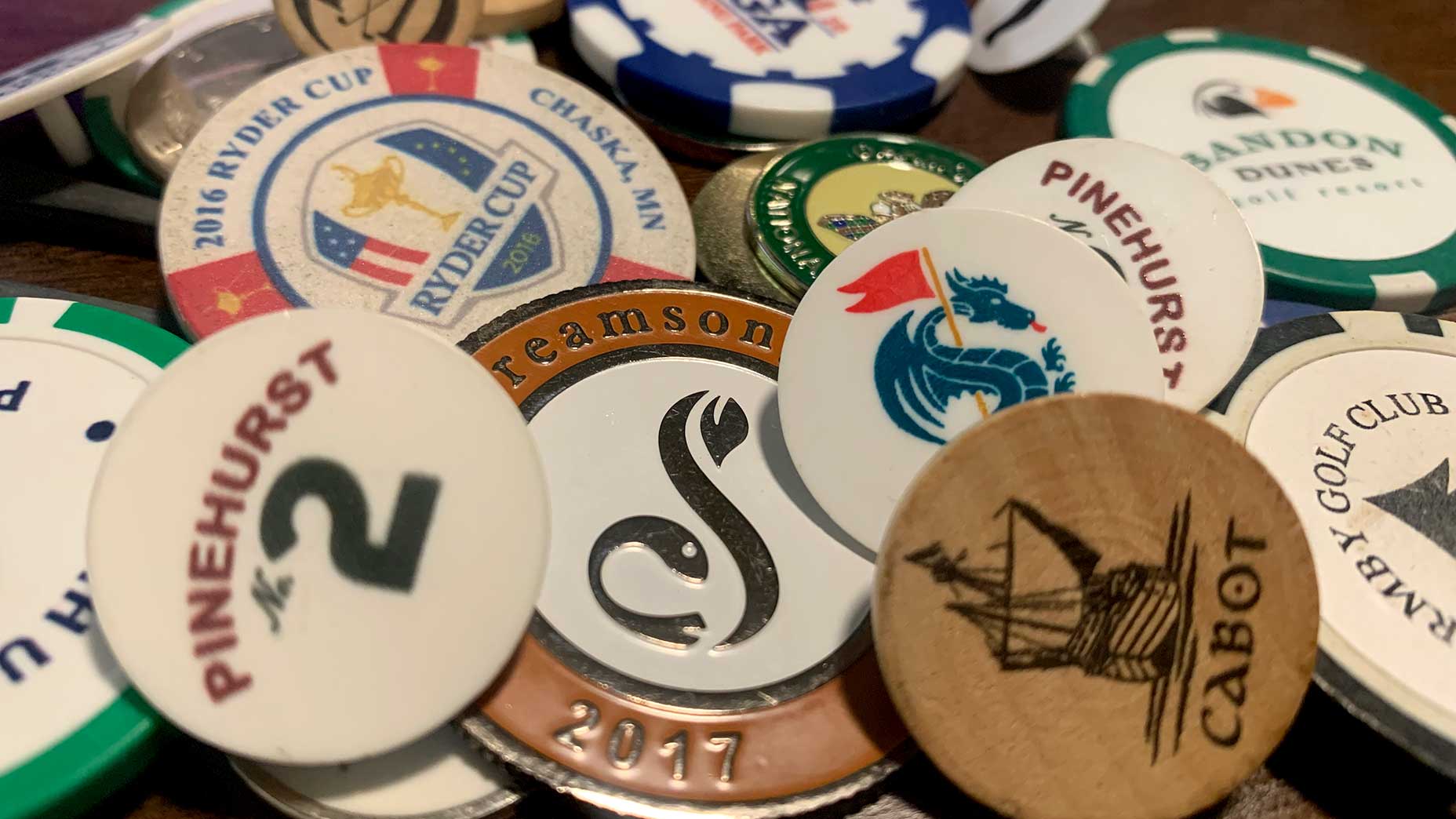
What are you wearing?
That’s not a come-on. It’s a serious question. This inquiring golfer would like to know.
If you’re headed to the course, odds are you’re cloaked in something with a logo. A hat. A shirt. A belt. Maybe all of the above. If you’re a Tour pro, you’re probably plastered with more emblems than a NASCAR jumpsuit. Brands pay handsomely for your support.
For most golfers, it’s the other way around. We pay for the privilege of wearing logos. Through pro shops, merch tents and online drops, we’re eager participants in an industry that has grown into a multibillion-dollar machine.
Money talks, as do the logos people buy. What they say is another matter. Consider golf club logos — an obsessively niche corner of the market — and the many messages they convey.
“(A) golf club logo is rarely a mere ornament,” the veteran golf journalist George Peper writes in his engaging forthcoming book, “The Best Logos in Golf” (to be published this fall by Back Nine Press). “It carries memory, identity and meaning. Sometimes it serves as an invitation; at others, a barrier — or even a passport.”
When they aren’t opening doors, inspiring conversation, arousing envy, admiration or irritation, club logos, of course, are often sparking debates and spawning rankings.
Who doesn’t love a best-of list?
Peper is no stranger to such rosters. In the 1980s, as the editor-in-chief of GOLF, he oversaw the launch of the magazine’s Top 100 Courses in the World franchise, a ranking that imposed no strict criteria for greatness. Ballots were tallied by tabulating numbers, but those numbers were rooted in personal taste.
To generate his list of logos, Peper employed a similar system, albeit with a smaller electorate. Only four people had a vote — the author and three “logomaniac” friends — though they worked from a ballot of 225 candidates, which itself was compiled with input from well-traveled golfers on both sides of the Atlantic, social media forums and magazine pieces.
The result is less a ranking than it is a roundup, and with good reason. As Peper concedes, there’s no meaningful distinction between the 63rd and 64th greatest logos, so why pretend? In lieu of a precise pecking order, he arranges the logos in tiers — 1 through 10, 11-20, 21-30, and on. Is Chicago Golf Club’s logo better than Kittansett’s? Peper doesn’t say. But he puts them both in the same bucket. Objectivity is not the objective. Peper isn’t after the definitive list, only a defensible one.
His defense rests on traits that he says separate “the best from the rest.” Beyond “design quality,” these include “distinctiveness,” “timelessness,” “simplicity” and “versatility.” Does it look as cool on the scorecard as it does on the security gate?
“Backstory” is another consideration, and it’s a biggie. Above all, the book is an entertaining excuse for Peper to tell stories about logos and the clubs they symbolize. Many of these tales are of the blue-blood, hidebound type that the old guard of the game has always loved relaying, involving the likes of Ben Hogan, Bobby Jones and Charles Blair Macdonald, whose National Golf Links — co-created with Seth Raynor — appears in the top 10 of the list. In Peper’s depiction, the folk-art figures squaring off in National’s logo convey the “same gritty resolve” that Macdonald displayed on the course as one of the top amateurs of his day.
Sprinkled through the book are historical tidbits fit for cocktail-hour banter and trivia nights. Take the passage on Myopia Hunt Club north of Boston, whose logo is a fox and a horn. The club was so named, we learn, because its four founding brothers suffered from poor eyesight. Good thing they had hounds to help them hunt. When they weren’t tracking foxes, the siblings enjoyed tennis, water sports and equestrian pursuits. Not as fond of horses, some members eventually split off and set up shop in Brookline at what became known as The Country Club. That institution’s squirrel logo, which is also in the book, once prompted its club historian to quip, “We’re probably the only club in the world that worships a rodent.” (Actually, Waterville’s logo is a rabbit, and it also makes the list)
Peper is a nimble writer, and his playful prose makes for a breezy read. Given much of the material he’s working with, though, you sometimes feel the urge to brush the dandruff off the page.
The author isn’t wrong to lean on tweedy details. But their prevalence in the book underscores an implicit bias. By relying so heavily on backstory, the list winds up favoring older and off-limits clubs with famous members and championship pasts — clubs, that is, with their own built-in mythology.
And that’s where things get knotty, because history is not distributed evenly across the game. An old private club has had generations to accumulate stories. A club with a famous membership, exclusive policies or a prestigious championship past comes with hits own mythology. Your local muni might boast an emblem with museum-of-art-worthy graphic design. But it can’t match the patina of, say, Scioto in Ohio, which boasts what seems to me an unremarkable logo but is also where Jack Nicklaus learned the game. It’s not necessarily better. There’s just more to say about it.
You get the gist. That the top 10 logos on Peper’s roster all represent intensely private enclaves — think Merion, Myopia, National, Sleepy Hollow and such — underscores a point that the author circles but never makes explicit: how closely we conflate the quality of a logo with the exclusivity of the club.
Fishers Island Club, for instance, which leads off the book, is signified by an image of the island with a flagstick planted in it. Is that really a great logo, or merely the logo for a great course that most golfers will never get to play?
To be sure, populism can be appealing, too, and the book includes a healthy handful of public-access courses. Among them is Sweetens Cove, with its whiskey-barrel logo, the Tennessee nine-holer that has morphed from underdog into mainstream darling. In its transformation, Sweetens reveals another truth about logos: just as their designs can evolve, so can the connotations around them.
Once a bootstrapping course with a cult allegiance, Sweetens has grown so popular that landing a tee time there is now every bit as tough as accessing some elusive private clubs. Along the way, its logo has become a kind of Everyman’s status marker, Fishers Island turned on its head.
What’s holds in academia applies to logos: People care a lot because the stakes are so small. Not surprisingly, the intimate, fetishistic culture around them has given rise to rules of etiquette. The book includes a chapter on them, credited to four anonymous contributors who, we’re told, drafted the guidelines in the men’s locker room at Maidstone.
“Don’t wear two of the same logo unless you’re a member of said club,” one edict reads. “No more than 1 logo ‘showing’ off the course,” another declares. “Poolside with Monterey Peninsula dragon hat and Ohoopee tee-shirt is too aggressive.” Also: “Sum total of ‘course rankings’ must be more than 20. Example: Don’t wear Pine Valley and Cypress Point at same time.”
You wouldn’t want to come off as pretentious, after all.
Which brings another point to mind. In my years writing about golf, I’ve played many of the courses on Peper’s list, but I’ve never purchased an item with a logo at any of them. That’s not because I’m cheap, though I am. It’s because I don’t like logos. Or at least, I don’t like flashing them.
I worry how people might interpret them. I’d hate for them to see me as that guy.
At their sweetest, logos are mementos. You went somewhere special and got something special to remember it by. In less savory forms, though, they’re off-putting and boastful. What’s the point, for instance, of Pine Valley’s members-only logo other than to demonstrate who’s in and who’s not?
Am I reading too much into it? Probably. But that’s how logos work—symbols of a place that can be personally revealing. By sharing my feelings about them, I’m telling you something about myself. The conclusion you might draw is that I’m a mess.
I wouldn’t argue. With all the money I’ve saved on logoed merch, maybe I should find a good psychiatrist.